An alternative 5-dimensional model
in theoretical physics
It's a model or conceptual structure suggested for
interpretations in theoretical physics in the first place,
but with a pattern returning in sciences of superposed levels
too.
In all its simplicity, without intricate mathematics and
despite debatable features, the schematic model may be useful
in getting a grasp of scientific data and it feels at the same
time congruent with common human experience.
In following files application of the model is tested
to main concepts of physics, such as
Forces, Matter and Vacant Space, Antimatter,
Charge, Electromagnetic waves, Spin etc.
Some of the main treats in the conceptual
model:
- Dimensions as building stones with a special definition
- The "Entirety" as the beginning
- 4th dimension degree (d-degree) identified as Direction
- Motions put into the scheme in their own, new place
- Infinities (written 00) redefined and incorporated
- A suggested interpretation of Charge as property.
- Dimension degree of analysis optional
- All advanced mathematics excluded. Some new, perhaps "odd"
and very simple arithmetic introduced for derivation of numbers
such as quotients in physics, with the hypothesis that they
ultimately originate from number of dimension degrees (see one
example below).
Here the model:
A dimension degree (d-degree) is in this model characterized
as the relation between 2 complementary "poles".
This principle of complementarity is central
(in agreement with treats in quantum mechanics too).
The definition of dimensions as the number of
"independent" variables is not accepted; everything
is assumed interrelated.
Polarizations are assumed as the elementary principle of
development'. It's assumed as responsible for steps towards lower
d-degrees.
Science seeks tracing manifoldness back to unity. The creation
of universe would presumably have the opposite direction.
Hence, this model starts with the "whole",
with the "Entirety". and this "Entirety" is
assumed as 5-dimensional, of one higher degree than the commonly
accepted 4 in established physics.
This doesn't exclude developments of more polarities
and dimensions - or fractals within each step in accordance with
theories of later decades.
The steps of polarizations in elementary geometrical
definitions:
5→4:
Starting point - at the border to metaphysics, at the triple point
between metaphysics, concepts and geometry, at Big Bang - is regarded
as a real point, a Zero, a "0-pole", a centre, in accordance
with accepted physical views but perhaps more extreme.
Complementary pole becomes the undefined opposite, the "infinity"
as a "00-pole" (∞, written 00).
This implies a redefining of the problematic
"infinity" to the concept of "anticenter".
These first definitions make up the first polarization
of the 5-dimensional "Entirety" to 0 and 00, centre
and anticenter, from which all following complementarities
are inherited.
4→3:
The 4-dimensional degree is defined as Direction.
Conceptually, that which is created through
a point (and its undefined surrounding) is directions outwards-inwards.
Geometrically this is vectors, in common definition
objects which in addition to positions in 3 dimensions also demand
the 4th specification of Direction.
Through polarization between outwards and inwards, here the complementary
"poles" (or partial structures") of d-degree 4,
principally anti-parallel, and with a loss of direction, a 3-dimensional
world of volumes for masses and space is created, and roughly
speaking with a radial - circular geometry (or with negative
- positive curvature) as geometrical poles. In other words: partial
structures with enclosed in opposition to excluded centres.
3→2:
The 3rd d-degree when polarized defines in its turn surfaces,
2-dimensional structures with geometries of the type "inside
- outside" or "convex - concave",. The
polarity can also be thought of as geometrically appearing in
sine curves.
2→1:
In this last structural step a polarization of surfaces are assumed
to lead to 1-dimensional structures as lines.
1→"0/00":
1-dimensional structures are assumed to polarize into Motions:
with "motions towards each other" (converging)
and "motions from each other", (diverging) as
the complementary "poles" in this step.
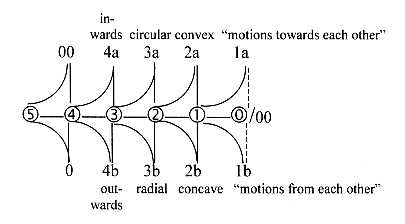
The types of geometrical complementarities in these
first "postulates" may be acceptable. In which way simple
polarizations create the geometries of the lower degrees out of
higher ones is a more serious question. The simple statements
above may rise immediate doubts.
Yet, the question is left here for later discussions.
The series of steps is called a "dimension
chain" and may be written:
5 → 4 → 3→ 2 → 1 →
0/00
In this chain of polarizations towards lower degrees each
step implies 1 d-degree debranched. Lost degrees in a unit
are interpreted as transformed into external motions.
There is also the alternative that lost degrees
as 1-dimensional structures meet "the other way around"
- in synthesizing direction, being built-in into structural element
in units of higher degrees.
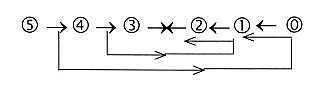
D-degree "0/00" of Motions:
Motions towards each other defines a centre, a zero or 0-pole;
motions from each other an anti-center, a 00-pole Still not the
same as the poles of the "Entirety" of d-degree 5.
This "dimension degree 0/00" of Motions
- corresponding to the concept of pure kinetic energy - can be
designated 5'.
Motions as concept becomes in this model the ultimate translation
of the 5th dimension degree, expressions for the underlying
unity, the "Entirety" stepwise transformed.
In this model Motions are regarded not only as relative but also
as absolute realities.
Time is regarded as
defined in the d-degree of motions, which also means that it is
evolved in first and each following steps towards lower d-degrees.
The d-degree of motions will increase when d-degree of structure
decreases. Hence, motions form a "counterdirected" chain
to the chain of structure.
Chain of motions 0/00
- 1 --- 2 --- 3 --- 4 --- 5 d-degrees
Chain of structures: 5
-- 4 --- 3 --- 2 --- 1 ---0/00 "
Structure of motions:
· Vibration in 1 dimension - in 4-dimensional vector fields?
· Rotation in 2 dimensions - by 3-dimensional bodies
· Motions in 3 dimensions - by "shells" or 2-dimensional
phenomena…(as in cell membranes)…
Compare, as an association, with the temperature (here) motions
in one- and two-atomic gases Ew = 3/2,
5/2 or 7/2
(times a constant, times Temperature).
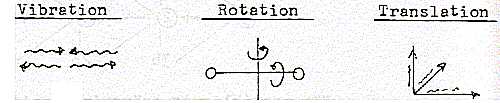
Analysis:
Dimensional degree of analysis will be optional, when d-degree
of motions are included.
Different models of the atom for example would
have the same validity, if external relations or motions are included:
analyses in vector fields, or particle models or the shell models.
We could add here: analysis in structures of 1-dimensional lines
or "strings".
The model implies that everything is interrelated
- at bottom. And if so, the 5 primary dimensions should manifest
themselves in all phenomenon we choose to study.
This is the basis of the model as a skeleton in terms of concepts
and geometries.
The model applied to main concepts of physics:
4th degree:
Here defined as Direction, could be identified with "fields"
in physics, with 4-dimensional Vector Fields (inwards Û
outwards) or pair of forces. (About Forces as concept below.)
In the first step 5→4, to centre and anticenter,
there is only the concept of pure Density, directions from a centre
illustrating a gradient of "near / far" from the centre.
Implicitly it contains such relations as Mass per Volume, or in
the other end of the dimension chain Frequency or Distance per
Time (velocity).
3rd degree:
Here as Volumes, geometrically defined as characterized by enclosed
/ excluded centre, are here identified with Mass and Vacant
Space, the opposition in the formula E = +/- mc2(Dirac);
that is in the aspect on Mass or Matter as e.g. celestial bodies
occupying space in a 3-dimensional room, that is when analysed
as 3-dimensional.
Steps (3) → 2 → 1 →0/00 will represent waves:
with degree of motions increasing, the structure gets increasing
motional character.
2nd degree:
Here is introduced the hypothesis that Charge as a 2-dimensional
property in relation to Mass when interpreted as 3-dimensional.
(In the 1960th a physicist as David Park pointed
to the fact that physicists didn't know what charge is. The hypothesis
here became the starting point to this model.)
The suggestion should imply that it would be
possible to find some difference of 1 dimension degree in the
mathematical equations that are connected with electric charge,
compared with equations related to masses - or matter. (About
the difference mass - matter, see that file).
Charges with opposite signs (+/-) may eventually
be regarded as represented by the opposite halves of coordinate
axes.
1st d-degree:
The degree of lines may represent the elementary concept of Distance,
but could also be identified with elementary potentials. Compare
too the concept of "field lines". In addition we have
path ways for particles or bodies like planets.
One suggestion here is to identify the d-degree steps themselves
with the concept Velocity and this polarized into Distance
and Time in the sense of "scales", that is 1-dimensional
physical entities.
Distances transform into Time in one direction,
Time into distances, change in relative positions, in the other
direction.
D-degree "0/00":
Motions as pure kinetic energy. Temperature will of
course be one concept in this d-degree of Motions.
The elementary concepts of physics in a dimension chain -
a first
rough identification.
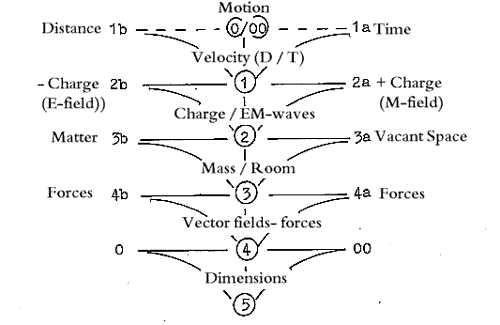
Some annotations:
The complementarity principle are the easily recognizable
in pairs as Mass - Vacant Space, charge (+) and (-), p---e, nucleus
and shell of the atoms, or quarks up and down, and will be a consequence
of a starting point, a centre. (They are In agreement with mythologies
too.)
(It should be noted that Bohr's "complementarity"
between momentum and position in Quantum mechanics not is of this
kind.)
The polarizations imply that 1 d-degree of the inner structure
of a unit gets transformed to outer motion. That's at least one
thing to say about them here. Compare how Einstein by using the
complex number √-1 (for Time) moved Time to the same side
of an equation as the 3 room coordinates and got a 4-dimensional
Space.
One example of a polarization in elementary
physics is the disintegration of neutrons outside the atoms: n
→ p + e, by "weak interaction". Most things however
which we recognize is already polarized realities and in that
sense - it's relations we perceive.
Unpolarized higher d-degrees seem as "superpositions
" in the sense of Quantum mechanics.
Entropy:
The development from higher to lower degrees in such a dimension
chain is in this respect in agreement with the energy law of entropy
- which still has its well-known opposite, as in the structuring
of life.
5 dimensions?
It differs probably in several aspects from the scientists' research
in 5-dimensional mathematics, those inspired for example by Theodor
Kaluza, but could eventually have connections with it as in
the file about forces which is called "MEGA-fields",
(magnetic, electric, gravitational and acceleration forces or
vector fields).
About counting with 5 dimensions, one should
observe that the common elementary coordinate system for 3 dimensions
presupposes, without mentioning it, a centre, an origin - and
signs (+) and ((-) on the opposite directed halves of the coordinate
axes: this means a couple of extra specifications in addition
to the 3 about x-y-z coordinates.
Abstractions:
It's a common view that "abstractions" represent "high
levels" of the human mind. Here concepts such as geometries
are understood as the opposite, very deep realities - in the bottom
of human mind and of the world.
There is a process of gradual substantiation
to the material world.
Matter;
Matter, versus "non-material" things should be a question
of (relative) structure.
Gradual substantiation:
The development toward our "material" and "anti-material"
world from both higher and lower d-degrees is regarded as a question
of increasing complexity and gradual substantiation.
Incorporation of the 00-pole:
A general aspect on development in the model is the gradually
building-in of the 00-pole, the anticenter as "surrounding"
into units representing centres. So in development towards life
.
This implies growing complexity in the centre-units
in relation to the surrounding as "anticenters".
Forces as a concept:
- The concept of "forces" has been discussed and sometimes
dissolved into mathematical relations. Still the concept of "forces"
seems to be indispensable, so in the concept of "carriers"
of forces, distinguished from other elementary particles, and
in the so-called 4 known forces in physics. It is of course central
in the standard model of quantum mechanics.
- When talking about "forces", emphasis is given to
something opposite to "structure", Relations however
has also the character of structure. This ambiguity fits very
well in this dimension model.
- Forces in the old definition is something that generates changes
in direction or velocity of motions. In the model here such changes
are primarily related to d-degree steps.
- Here the opposition is introduced between binding and polarizing
forces, and the simple starting point that the bond between two
parts of a unit is the unit of which they are, or "were",
parts.
- According to that statement, the binding force in each dimension
degree is assumed to be the next higher dimension degree. Then
the 4th dimension degree constitutes the binding force in the
3rd dimension degree, the 3rd in the 2nd and so on. And a line,
or distance, is the binding force in motions. (Apparently
so in human beings' building of roads and railways as materialization
of distances and then using different vehicles to "bind the
endpoints together"!).
- In the opposite direction we ought to have the polarizing forces,
from lower to next higher dimension degree.
- Then a "force" can be defined as one dimension degree
operating upon next lower or higher degree, the latter seen or
analysed as structure.
- A dimension could superficially be resembled with a rubber
band that is stretched. The binding force is the contracting,
inner, chemical force in the rubber material itself. The polarizing,
stretching force comes from the outside.
- With these assumptions Structure and Force (or pair of forces)
show up as two aspects on a dimension, depending on the starting
point of the analysis. The concept of force is in a simple way
traced the back to the concept of dimension.
(Einstein mentioned in a book from 1960th the
difficulty for physicists to derive a particle or atomistic world
from field theories of that time. In some sense it could be just
a question of different aspects on the same thing and the d-degree
of analysis. See later files about mass and step 4→3.)
- It's worth remembering that the proton p (H+) and
the electron (e-) are real "carrier of forces"
in biochemical processes on a superposed level, in spite of being
fermions and not having integer spin. The same view may be applied
to all organisms on the biological level, acting as forces. And,
on the ground level, pure motions are forces, as a fist hitting
something. Such aspects support the interpretation of forces as
a question about relations between dimensions.
- At the same time it's possible to identify vector fields of
4th d-degree as representing primary forces in usual physical
sense with forces often illustrated by vectors. Here the difference
between bosons and fermions miss mass would be applicable including
the difference in complexity of spin.
Following view is adopted in the model:
Main, first "binding force" will be the 5th d-degree,
the "Entirety", transformed and expressed in all motions
and dynamic processes in Universe.
Polarized into d-degree 4 between 0 and 00,
center and anticenter, these poles are assumed as next primary
forces:
- the 0-pole (the center) as the secondary binding, integrating
force, "from inside",
- the 00-pole (the anticenter) secondarily as a polarizing force,
still, as part of d-degree 5 primarily also with the character
of an "aggregating" force. "From outside".
The relation may be elucidated by viewing the dimension chain
as "haploid", ( 0 → 4 →3 →2 →
1 →00) where only the 0-pole develops towards closed units
and materialization, while the 00-pole meats the other way around
in each step: there is always an undefined surrounding for a unit
as a center-pole
Relations between lower and higher d-degrees
are also of the kind 00 to 0: manifolds versus unity, for instance
an infinity of surfaces in a volume, of lines in a surface.
Polarizing and binding forces in other words: Surroundings separate
the force or Directions from the center, gets integrated by the
center. (As in Biology).
A similar relation could be found between concepts
as continuum versus quantified realities or fields: the 00-pole
as the quantifying one, continuum from the 0-pole the one that
gets quantified.
Active forces should presumably be identified with just
one of the poles of a dimension degree. A usual statement is that
a force always awake its opposite force. (But note: not necessary
anti-parallel, in most cases not, according to this model.)
Since all "b-/and a-poles" of lower
degrees inherit features from the 0-and 00-poles respectively,
this would be a logical consequence.
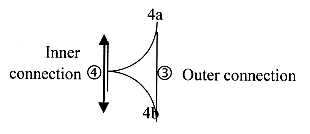
The concept of connection is ambiguous: The structural
or outer connection between for instance poles 4b and 4a is in
this model d-degree 3. While the deeper, perhaps expressible as
"operational" relation goes through d-degree 4 as an
inner, underlying connection, the common origin.
Structure - process - motions:
A dimension chain 5 →4 →3 →2 →1 →0/00
can be understood as a dynamic process of polarizations, of dimension
steps.
We can also focus on the dimension degrees themselves
as potentials instead of the steps and see the chain as a structure
- like a standing wave can be seen as a structure. We choose then
a static view.
Static/dynamic or structure/process becomes
two aspects on dimension chains.
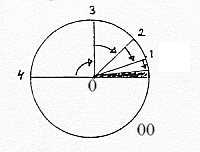
An assumption about angle steps:
There is also in this model a tentative assumption that the d-degree
steps geometrically can be characterized by angle steps: in simplest
illustration as halvings:
|
D-degree
|
5
|
360°
|
poles c - ac
|
| |
4
|
180°
|
antiparallel
|
| |
3
|
90°
|
orthogonal
|
| |
2
|
45°
|
sin = cos
|
| |
1
|
22,5°
|
|
| |
0/00
|
11,25°
|
|
Such steps may imply enclosing of a center, defining a "separate"
unit, leaving an open rest angle for the communication with the
outer world, the "00-pole".
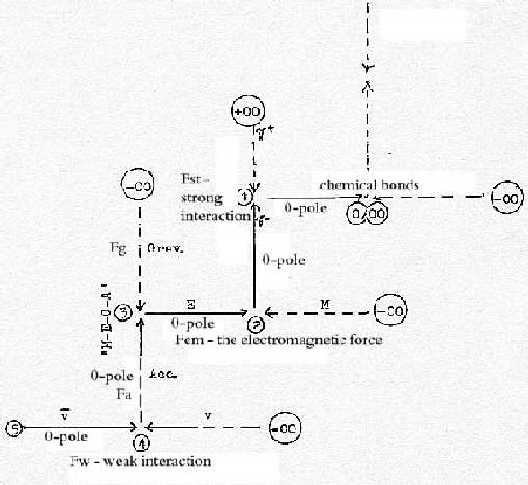
Level development:
Shortly: Two thoughts:
a) A development toward higher levels - as a "level chain"
through step 3-2; the primary dimension chain is viewed perpendicular,
d-degree steps meeting in the middle, in step 3 → ↑.
See illustration below (from file Forces).
b) A development of new dimension chains as secondary"loops"
in each step of the primary chain, possible to interpret as
"fractals".
Example: vector fields as such developing through a whole dimension
chain, properties as Mass and Charge likewise developing in
such secondary chains...
It seems as if the two assumptions turn out
to be different aspects on the same dimensional development
of new "levels".
Mathematics:
One example of the kind of simple arithmetic here and there in
these texts:
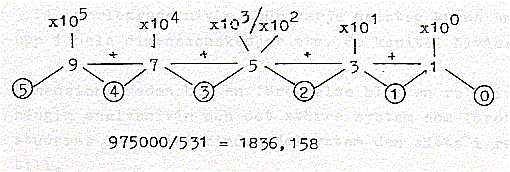
Look at the superposed number chain 9-7-5-3-1.
The quotient between the rest masses of proton
and electron is given at 1836.12 (data from 1973).. The
proton has most of the mass, d-degree 3, the electron form the
atomic shell, d-degree 2.
According to Gamow the proton and the electron
have about the same energy if the kinetic energy of the electron
is taken into account.
(One assumption about numbers is that a d-degree
step in some contexts could represent a 10-power step.).
*
For a more detailed survey of content in following
files on physics, see here:
To next file: Forces
|